Hail, travelers!
I’ve talked about the comforting nature of Dungeon Synth in my previous blog post. After having conducted lengthy musings from my part, I’ve come up with yet another perspective which I think might resonate with a lot of Dungeon Synth fans out there. It wasn’t my original intent to make a continuation of my previous post, but I go wherever my pen decides I should go. I’m not sure if this will become a series of sorts, but it is possible I will talk about more “natures” of Dungeon Synth in the future. Maybe I’ll call it the Nature of Dungeon Synth series. 😉 Grab a sturdy walking cane, and walk with me as I share my musings with you. It will take us some time before we reach the end.
First, I’ll have to establish and agree upon a clear definition of the term escapism. According to the Merriam-Webster dictionary, escapism is the habitual diversion of the mind to purely imaginative activity or entertainment as an escape from reality. Escapism, as I see it, can take many forms, some more constructive than others. From creative pursuits, to enjoying how a sports game unfolds, watching a movie, gaming or reading the latest celebrity gossip; escapism is all around us and is a fundamental part of what it means to live a free human life. I agree some forms or escapism are not constructive, though that in itself does not reduce its impact for the person involved. I also agree that constructive escapism is psychologically more valuable in the long run. For it to become constructive, you have to able to pour at least a portion of yourself as a person into the activity, as well be able to draw from it to become inspired. To some, however, escapism has become synonymous with laziness, inefficiency, idle daydreaming, and worthlessness, reducing it to a dirty word. I wholeheartedly disagree; escapism has been with us since the dawn of our existence as a sapient species, and will continue to do so. It is one of the most powerful driving forces humans can experience, for it is tied to hope.

Fief V
Music has the ability to evoke a sense of escapism for musicians and listeners alike, and Dungeon Synth is no exception. In fact, I would go so far as to suggest Dungeon Synth might be one of the best genres in this regard. But why is that my opinion? I’ve come to see escapism as a crown which many Dungeon Synth artists have donned in the past. Indulge me as I disassemble this impressive crown into three equal parts to explain my point. I doubt the genre would exist without any of them.
The three parts I’ve identified are creative freedom, the choice of instrumentation, and imagination, and they all play an equally important role to make Dungeon Synth an evocative music genre.
Creative Freedom
I have touched on creative freedom in my previous post, but I think it is even more important to address it here. Even though I believe each part of the crown is equally important to make Dungeon Synth work as an escapist music genre, I believe it is creative freedom where the creation of a Dungeon Synth release really starts. Aside from a few noteworthy exceptions, there are usually no big expectations when it comes to Dungeon Synth releases. The artists dwell, even flourish in the obscurity which has become synonymous with the genre. There are no duplicitous record deals, no mandatory trends to be checked off, and no back-breaking touring quotas to be met. The artist and that person’s creative vision are the centerpieces of the music rather than extensions of a music genre, and it allows for the artist to make a deep dive. Many insecure artists might feel overwhelmed when they try their hand at music, but the obscurity of Dungeon Synth lowers the pressure any budding and insecure artists might feel when they give it a shot. It also helps that the majority of the Dungeon Synth scene is very welcoming towards new talent, and it is usually shown it by sharing their authentic appreciation of the music. This appreciation spurs their creative freedom to newer heights, which is lovely to see.
Since most Dungeon Synth projects are solo, they can take all the time they need to create their vision. There are probably hundreds of artists both aspiring and experienced which are writing new music in their attic or otherwise isolated locale as I write this blog post, some of which we will never get a chance to listen to. They can create their music in secret, which is simultaneously thrilling and comforting. This creative freedom is being facilitated by a no-strings attached DIY-approach, the incentive to experiment, and the genre’s peculiar instrumentation, which we’ll get into now.
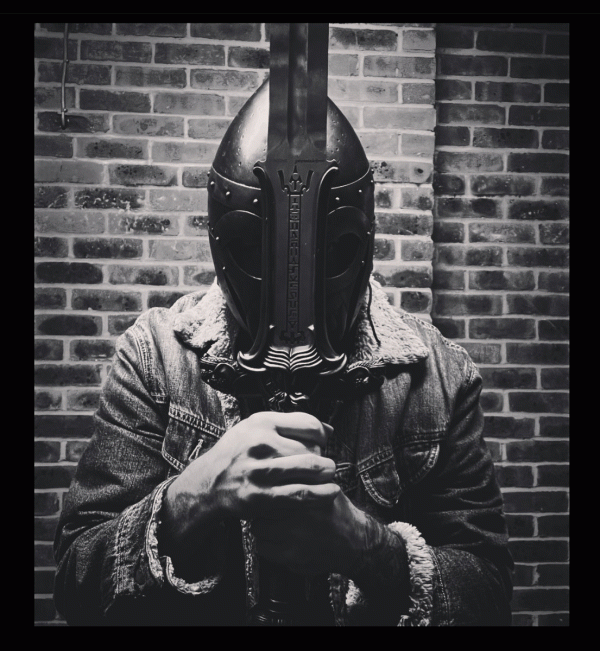
© Atlantean Sword
Instrumentation
Even during its infancy years, Dungeon Synth has had a taste for peculiar musical instrumentation. However, we can all agree the genre would not exist without the keyboard. It remains the most important instrument in the genre because of its monumental versatility. From the minimalistic tunes of the old-school practitioners to the more epic composers, it all usually starts with the keyboard. It has the ability to emulate a score of musical instruments or sound effects to the point where it can sometimes replace an ensemble of musicians. Not every Dungeon Synth artist uses the keyboard this way, but those who do often create soundscapes or dreamworlds with just a couple of touches. The sound of a keyboard can be molded fairly easy to suit an enchanting, nostalgic or melancholic atmosphere. It is truly a marvelous instrument, offering infinite solutions to those who are willing to delve into its potential.
However, Dungeon Synth doesn’t end with the keyboard. There are many who use other instruments as well, most notably guitars, flutes, and all sorts of percussion instruments, creating an organic hodgepodge which is particularly effective for those who want to give their Dungeon Synth a historical flair. Some even go the extra mile by throwing in sound effects, ambient, noise, samples, spoken word passages, or even singing into the mix to make their vision come to live. Artists who feel inspired by video game music may even implement sound effects from the 8-bit or 16-bit eras. The possibilities are endless, which makes for a lovely incentive for any escapist to dive into.
What is also peculiar about the instrumentation used in Dungeon Synth is that it usually doesn’t revolve around the creation of typical song structures. It is methodically slow by nature, and doesn’t seek musical climaxes in the traditional sense. The music serves the purpose of maintaining a particular atmosphere. This can be incredibly powerful while remaining subtle at the same time. If done right, the simplest of keyboard melodies can conjure up images of worlds, which brings me to the third part.
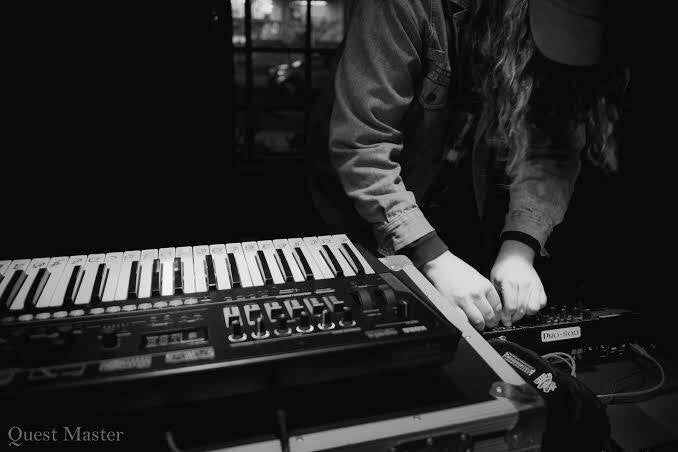
© Quest Master
Imagination
Dungeon Synth is no stranger to fictional themes, particularly the literary subgenre fantasy. Even though fantasy is the most popular theme in Dungeon Synth by far, Arthurian legends, mythology, history, science-fiction, nature, cosmology, horror, and other themes besides have their own place within the vast scope that is Dungeon Synth. However, fantasy remains the key word, not as a literary genre, but as the primary concept around which the genre is built upon. Fantasy is often used, subconsciously or not, as a metaphor on how we perceive the world around us. To fantasize is a wondrous thing, and can lead to wonderful revelations. How many of us have wished for something more aside from our mundane world? A make-believe daydream is a wish buried deeply within the soul, and Dungeon Synth has the power to turn this daydream into music through escapism. It may even accomplish something more than the audial manifestation of a daydream. It may contain portions of one’s soul. Some become proficient worldbuilders, while others choose to pursue less ambitious concepts.
I’ve come to regard many acts in the Dungeon Synth scene as a power fantasy in much the same way as a roleplaying game or cosplay. The players adopt a role, possibly the best version of how they see themselves in a metaphoric way. In my experience, the same often applies to Dungeon Synth artists.
Those who are into tabletop roleplaying games may have heard of esteemed Game Master Brennan Lee Mulligan. He once described characters created and played by the players as follows, and I think there’s a wonderful parallel with Dungeon Synth:
My favorite metaphor of character playing has always been that characters are translucent and not opaque - where they’re like stained glass.
You, the person are the light behind the stained glass.
And what the character is - it is always still you, but the colors and shapes and the way the things are arranged changes and the light shines through differently.

© RysaieArts
Dungeon Synth distorts in a similar way. It may adopt unusual shapes and colors, but it is always in an authentic way. Many Dungeon Synth artists use costumes (some are simple, some are impressively elaborate) and aliases, emboldening them to perform acts of courage they would otherwise be hesitant to consider. At the same time, it protects the artists. I’ve touched on the perception that to be a Dungeon Synth artist is to be heroic to an extent on previous occasions throughout this website, and I still stand by it. They follow their gut and during performances even surrender a portion of that anonymity in favor of a glimpse of vulnerability, which takes tremendous amounts of courage to pull off. This does not mean the music needs to be equally heroic or epic by default; that choice is up to the artist.
The illustrious Erang once made an album called Within The Land Of My Imagination I Am The Only God. This is such a powerful statement, and I think it rings true for any Dungeon Synth artist.
I find this to be a wonderful note to end the blog post with. It was by far the most extensive blog post I’ve written so far, and conceptually the most challenging. Let me know if you feel the same way, or if you think differently. All opinions or insights are welcome!
Until next time!
#dungeonsynth #escapism #roleplaying
Add comment
Comments